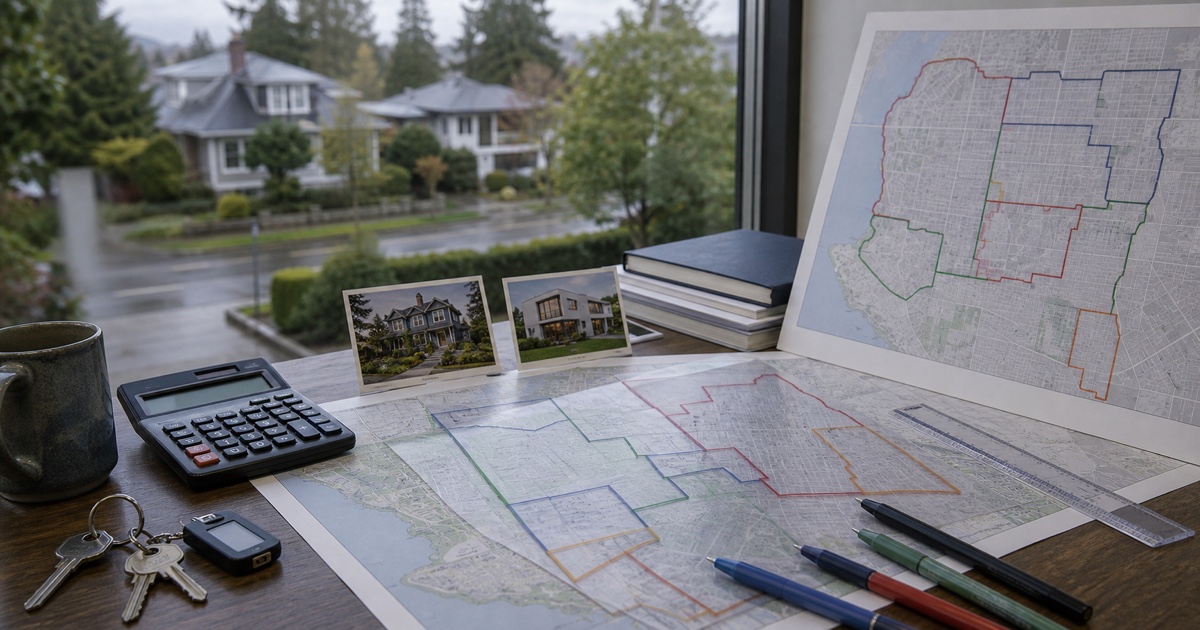
Vancouver West Side Catchment Depth: Why "The Line" Dictates Million-Dollar Premiums
A deep-dive analysis into the value-forming mechanisms of elite school catchments in the Vancouver West Side. Deconstructs the "Catchment Cliff" effect, the impact of Broadway SkyTrain extension on RS-zoned land, and the strategic risks associated with catchment boundary adjustments by the VSB. Essential reading for high-net-worth families and legacy asset investors.
Updated 2026-05-18
This article is organized from 9 public sources, last fact-checked 2026-05-28; full sources and review status appear after the article.
Research Notes and Decision Checklist
Key takeaways
- A deep-dive analysis into the value-forming mechanisms of elite school catchments in the Vancouver West Side. Deconstructs the "Catchment Cliff" effect, the impact of Broadway SkyTrain extension on RS-zoned land, and the strategic risks associated with catchment boundary adjustments by the VSB. Essential reading for high-net-worth families and legacy asset investors.
- Confirm the facts that apply to the specific property, city, and timing before relying on any general market observation.
- Bring unresolved legal, tax, financing, inspection, or insurance questions to the appropriate licensed professional.
Who this is for
Buyers, investors, families, and advisors who need a clearer way to organize Canadian real estate information before making a decision.
When to use PropertyLens
Use PropertyLens when you already have a target address and want a structured property report before deeper due diligence.
Decision checklist
- 1Identify the specific decision you are trying to make.
- 2Separate confirmed facts from assumptions that still need verification.
- 3Turn every unresolved issue into a follow-up question for the right professional.

In the Metro Vancouver real estate hierarchy, the West Side is built on a foundation of elite private institutions and Tier-1 public school catchments. For the professional investor, the logic of the West Side isn't about short-term appreciation—it’s about the "Permanent Moat" created by global demand for education.
Article Navigation
- The Catchment Cliff: Data-Driven Price Gaps
- Energy Shifts: The Broadway Extension and Rezoning
- Strategic Risk: The "Black Swan" of Boundary Adjustments
- Extended Reading
- Frequently Asked Questions FAQ
The Catchment Cliff: Data-Driven Price Gaps
On the West Side, being on the "wrong side of the street"—meaning outside a specific school boundary—can result in an immediate 10-15% price discount for similar lots.
Target Institutions
- Lord Byng Secondary: The crown jewel of Point Grey. Cross-catchment entry is statistically nearly impossible, pinning property values to the land.
- University Hill (U-Hill): Benefits from the proximity to UBC and a global cohort of high-net-worth families, creating a self-sustaining academic culture.
Energy Shifts: The Broadway Extension and Rezoning
[!IMPORTANT] Analyst View: As the Broadway SkyTrain extends toward Arbutus, the West Side is transitioning from "Car-Only Luxury" to "High-Density Transit Accessibility." Under BC Bill 44, older RS lots in these catchments are seeing a value shift from "Single-Mansion Estate" to "Multiplex Development Potential."
Strategic Risk: The "Black Swan" of Boundary Adjustments
[!WARNING] Boundary Flux: School boundaries are not permanent. The Vancouver School Board (VSB) retains the right to redistribute catchment areas based on enrollment pressure. If you purchase an asset on the "fringe" of a top catchment, your asset value could face a significant haircut if the line moves.
Frequently Asked Questions FAQ
Q1: Does proximity to a private school increase home value?
A: Not as linearly as a top public school. Private schools (e.g., St. George’s, York House) do not have geographic restrictions for entry, so while they create a prestigious neighborhood feel, they don't create the same "forced location demand" as a public catchment.
Q2: Is the West Side "大地屋" (Large Lot) still a growth play?
A: Yes, but the logic has changed. Value is now driven by Density Potential and the ability to build multiple high-end strata units on a single historic lot.
Q3: What is the biggest catchment-line mistake?
A: Assuming the school name alone protects value. Boundary changes, property type, commute friction, and buyer affordability still drive resale depth.
Extended Reading
- Vancouver vs. Toronto Affordability War: Decoding the Price-to-Reality Gap
- Interest Rate Transmission: How Bank of Canada Decisions Dictate Your Mortgage Cost
- Decoding CMHC Market Signals: How Professional Investors Use "Health Indicators" to Hedge Risk
Next Steps
In the West Side, you aren't just buying square footage; you are buying a seat at the table of global elite education.
Get the West Side School Catchment & Land Value Map →
About the Author: Senior Education & Real Estate Analyst specializing in West Side land tenure and demographic shifts.
Disclaimer: Catchment data is subject to VSB policy updates. Always verify current boundaries with the school board before acquisition.
Sources and Fact-Check Status
- BC Ministry of Education and Child Care School Locator (BC Ministry of Education and Child Care School Locator · 2026-05-28)
- Vancouver School Board School Locator (Vancouver School Board School Locator · 2026-05-28)
- Fraser Institute School Rankings (Fraser Institute School Rankings · 2026-05-28)
- TransLink Projects and Plans (TransLink Projects and Plans · 2026-05-28)
- City of Vancouver Planning, Urban Design and Sustainability (City of Vancouver Planning, Urban Design and Sustainability · 2026-05-28)
- BC Transit Planning (BC Transit Planning · 2026-05-28)
- CMHC Housing Market Information Portal (CMHC Housing Market Information Portal · 2026-05-28)
- Statistics Canada Housing Statistics Portal (Statistics Canada Housing Statistics Portal · 2026-05-28)
- CREA National Statistics (CREA National Statistics · 2026-05-28)
Related Reading
Vancouver and BC Regional Intelligence
Neighbourhood Selection
School Rankings and Real Estate: Deconstructing the "Fraser Myth" for Strategic Selection
Fraser Institute rankings are a navigation tool for parents, but the "social capital" behind the numbers is the true driver of property resilience.
Neighbourhood Selection
Family Living in Canada's Core Cities: Vancouver & Toronto 2026
Deciding between the mountains of Vancouver and the energy of Toronto? We analyze the best family neighborhoods and market forecasts for 2026.
Financing and Affordability
Vancouver vs. Toronto Affordability War: Decoding the "Price-to-Reality" Gap for Investors
Vancouver and Toronto consistently top global "bubble" and affordability charts. This analysis moves beyond headlines to compare the underlying fundamental drivers in Canada’s two most expensive cities.
InsightEstate.CA
Return to Property Intelligence Lab for more Canadian real estate research and practical analysis.