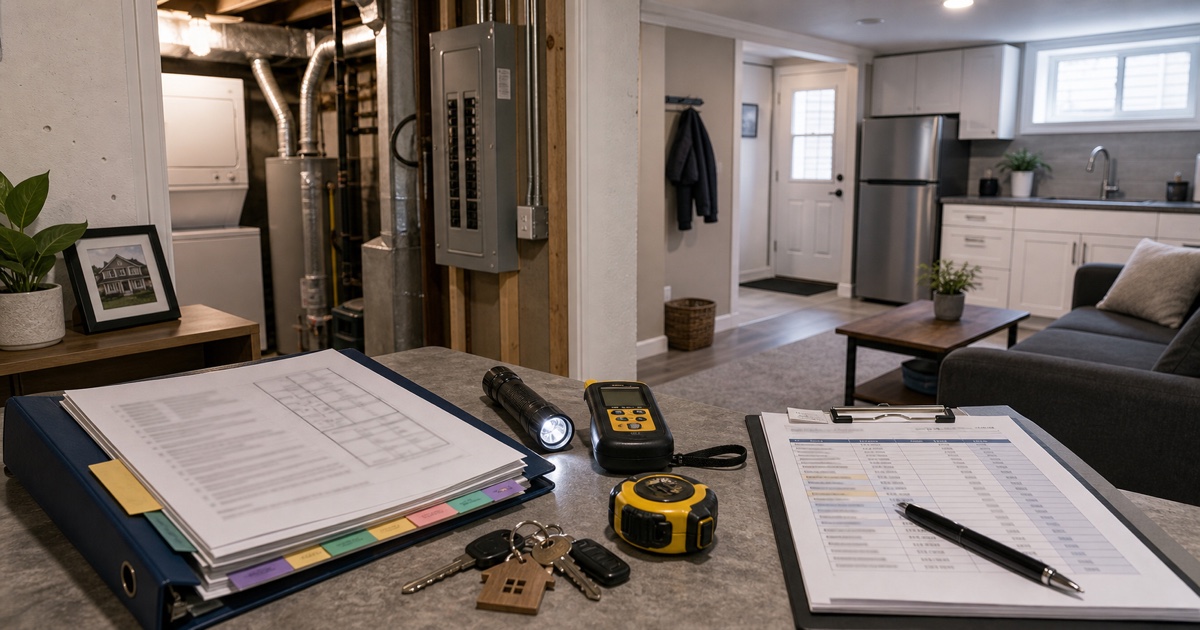
The "Mortgage Helper" Trap: Why Illegal Suites Are a Growing Financial Risk in BC
A deep dive into the legal and financial liabilities of illegal suites in Metro Vancouver. Covers building code requirements, the risk of insurance denial, and a step-by-step permit search guide for buyers.
Updated 2026-05-18
This article is organized from 3 public sources, last fact-checked 2026-06-02; full sources and review status appear after the article.
Research Notes and Decision Checklist
Key takeaways
- A deep dive into the legal and financial liabilities of illegal suites in Metro Vancouver. Covers building code requirements, the risk of insurance denial, and a step-by-step permit search guide for buyers.
- Confirm the facts that apply to the specific property, city, and timing before relying on any general market observation.
- Bring unresolved legal, tax, financing, inspection, or insurance questions to the appropriate licensed professional.
Who this is for
Buyers, investors, families, and advisors who need a clearer way to organize Canadian real estate information before making a decision.
When to use PropertyLens
Use PropertyLens when you already have a target address and want a structured property report before deeper due diligence.
Decision checklist
- 1Identify the specific decision you are trying to make.
- 2Separate confirmed facts from assumptions that still need verification.
- 3Turn every unresolved issue into a follow-up question for the right professional.

In the Metro Vancouver real estate market, the phrase "mortgage helper" is a powerful selling point. However, as an analyst, I must offer a cooling reality check: over 60% of secondary suites in the region are technically "unauthorized" or "illegal."
While these suites provide vital cash flow during stable times, they become financial time bombs during a crisis. Understanding the gap between "existing" and "legal" is crucial for any serious investor.
Article Navigation
- The Legal Truth: Physical vs. Administrative Standards
- The Risk Matrix: Three Levels of Liability
- Financial Threats: The Invisible Wall
- Action Checklist: Permit Due Diligence
- Suite Income Reliability Test
- Frequently Asked Questions FAQ
The Legal Truth: Physical vs. Administrative Standards
A suite might have been rented for 20 years without a single complaint, but that does not make it legal. In Vancouver, a Legal Secondary Suite must meet specific BC Building Code and zoning requirements.
Core Requirements for a Legal Suite
| Feature | Legal Standard (BC Building Code) | Rationale |
|---|---|---|
| Separate Entrance | Mandatory | Direct access to the exterior without passing through main house |
| Ceiling Height | Min 6' 5" (2.0m) | Fire safety and livability standards |
| Fire Separation | Mandatory | Two layers of fire-rated drywall between units |
| Ventilation | Independent | Dedicated exhaust for kitchen and bathroom |
| Final Permit | Occupancy Certificate | Formal proof of municipal inspection and approval |
The Risk Matrix: Three Levels of Liability
Investors must distinguish between "Unauthorized" and "Dangerous."
[!CAUTION] Safety Warning: An unpermitted suite with a shared furnace or no fire separation is more than just a paperwork issue; it’s a life-safety risk that places the owner under immense legal vulnerability.
- City Enforcement: Usually triggered by neighbor complaints (often over parking). An inspector can order you to remove the kitchen within 30 days.
- Tenant Litigation: If a tenant is injured in an illegal suite, courts often hold the landlord to a "strict liability" standard for failing to provide safe housing.
- De-valuation: When it’s time to sell, savvy buyers will demand a price reduction equal to the cost of "legalizing" the unit (often $40k–$80k).
Financial Threats: The Invisible Wall
The Insurance Void
If you fail to disclose an illegal suite to your insurer, and a fire starts in that unit (e.g., from an unpermitted stove), the company has a high probability of denying the entire claim. You could lose the property while still owing the bank the full mortgage.
The Lending Gap
As interest rates remain high, banks are tightening their "Rental Inclusion Rates." Many lenders only recognize 50%–70% of income from illegal suites—or none at all—significantly reducing your borrowing power.
Action Checklist: Permit Due Diligence
Before making an offer, you must verify the property’s "Permit History."
- FOI Request: Request the "Property File" from the municipality to see all historical Building Permits.
- Blueprint Comparison: Does the city's floor plan match the current layout? If the plan shows a "storage room" but the house has a kitchen and bedroom, it's unpermitted.
- Electrical Audit: Check if the service was upgraded (e.g., from 100 Amp to 200 Amp) to handle the additional suite load.
Frequently Asked Questions FAQ
Q1: If I bought the house with the suite, am I responsible?
A: Yes. The principle of Caveat Emptor (buyers must evaluate carefully) applies. Once you are the owner, you inherit all historical violations and liabilities.
Q2: Can any suite be legalized?
A: Not always. Some zoning doesn't allow for secondary suites (though Bill 44 is changing this), and some physical constraints (like ceiling height) are too expensive to fix.
Suite Income Reliability Test
A mortgage helper should be underwritten as evidence-based income, not as listing copy. The first test is legal status: zoning permission, permit history, occupancy approval, fire separation, egress, ceiling height, electrical work, and parking requirements. If the unit cannot pass this screen, its rent should be discounted heavily in valuation.
The second test is insurability and financing. Some lenders may not credit unauthorized suite income, and some insurers may restrict coverage if the suite was not disclosed or built safely. That creates a double risk: the buyer may qualify on optimistic income while carrying a loss that is not fully covered after an incident.
The third test is tenant continuity. Even if the suite has been rented for years, enforcement, neighbour complaints, or major repairs can interrupt income. A conservative offer should model vacancy, compliance upgrades, and possible conversion back to owner use.
Q3: Can buyers rely on unauthorized suite rent for valuation?
A: Only with a large risk discount. Buyers should verify permits, lender treatment, insurance coverage, safety standards, and enforcement exposure before counting the income.
Extended Reading
- The End of Single-Family Zoning: How BC Bill 44 (SSMUH) Reshapes Real Estate Investment
- Vancouver Real Estate 2026: Redefining Your Financial Model for the Rate Correction Era
- Title Search Deep Dive: 3 Overlooked Details Beyond Home Inspections
Next Steps
Don't buy a liability masquerading as an asset.
Get a Professional Permit & Compliance Audit →
About the Author: Forensic Real Estate Analyst focused on risk mitigation and municipal compliance in the BC lower mainland.
Disclaimer: This article is not legal advice. Building codes and enforcement varies by municipality.
Sources and Fact-Check Status
- Secondary suites (Government of British Columbia · 2026-06-02)
- Building or renovating a home (Government of British Columbia · 2026-06-02)
- Residential Tenancy Branch (Government of British Columbia · 2026-06-02)
Related Reading
Vancouver and BC Regional Intelligence
Due Diligence
Beyond the Walls: 3 Overlooked Title Search Details that Can Derail Your Investment
A home inspection checks the physical structure, but a Title Search checks the legal structure. This article reveals the "hidden burdens" that can cost you thousands.
Renovation and Building Risk
The Renovation Permit ROI: Controlling Costs and "Legalizing" Your Premium
Renovation is more than an aesthetic project; it is a regulatory game of chess. No-permit work is a debt; permitted work is an asset.
Landlord Operations
The BC Residential Tenancy Act (RTA) Field Guide: Protecting Yields in the "Tenant Era"
BC’s rental policies are increasingly protective of tenants. This guide decodes the 2024-2025 legislative shifts and provides a legal compliance roadmap for investor-landlords.
InsightEstate.CA
Return to Property Intelligence Lab for more Canadian real estate research and practical analysis.